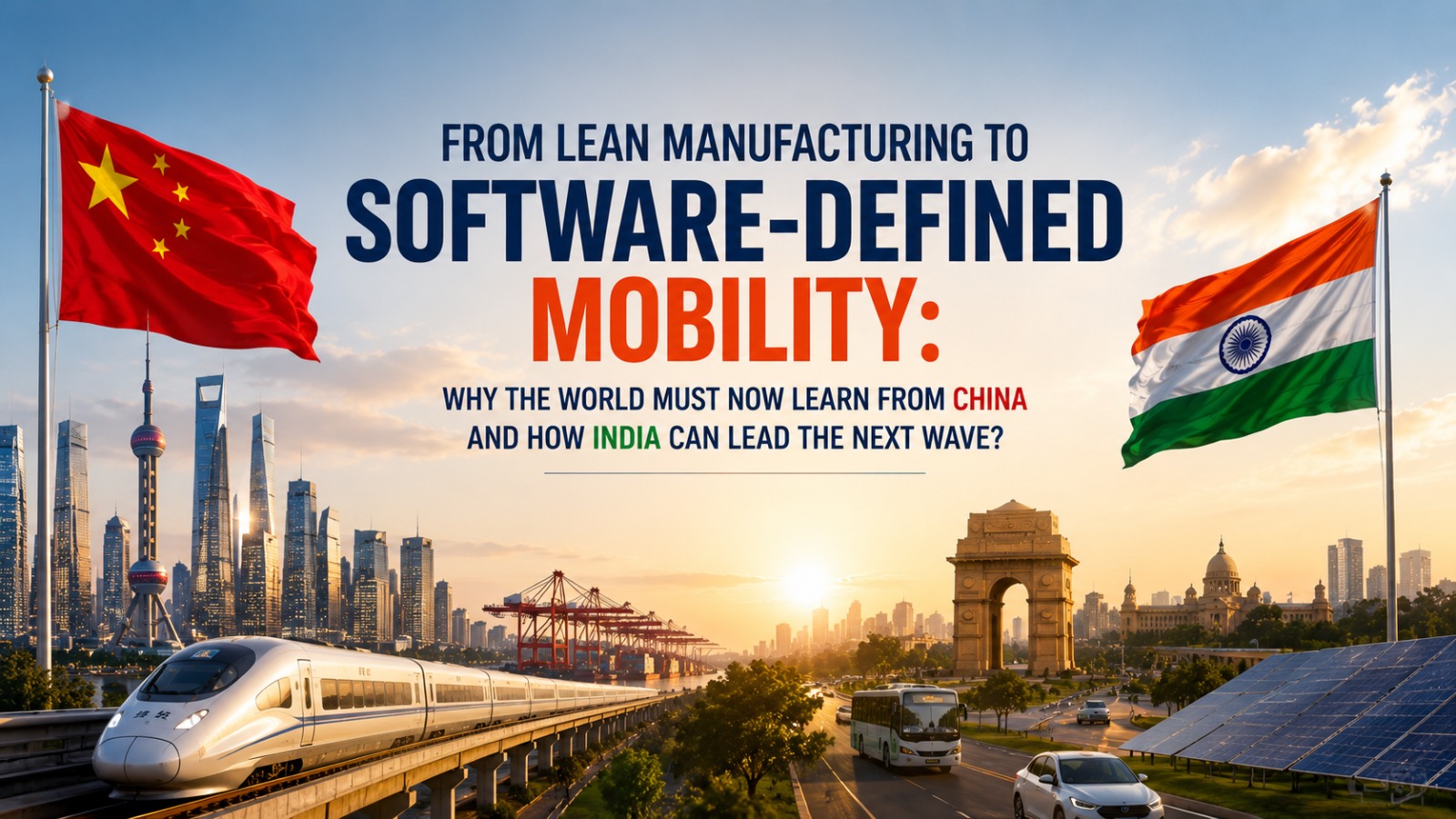
There was a time not too long ago when the global automotive industry looked East for answers. In the 1970s through the 1990s, as Japan rose to industrial prominence, the narrative was clear: if you wanted to build reliable, efficient, and scalable automotive systems, you studied Japan. Companies like Toyota and Honda didn’t just compete, they redefined the rules of manufacturing excellence. Lean production, just-in-time supply chains, and uncompromising quality became global benchmarks. Western OEMs didn’t just admire Japan, they adapted, partnered, and in many cases, restructured themselves to stay relevant.
Today, in 2026, we are witnessing a similar but fundamentally more transformative shift.
Only this time, the center of gravity is China.
China’s Rise: Not Cost Leadership, but Innovation Leadership
For years, China was viewed through a narrow lens in the automotive sector—primarily as a cost-efficient manufacturing hub. That perception is now outdated.
Companies like BYD and NIO are not just producing vehicles; they are redefining what a vehicle is. Software-defined architectures, vertically integrated battery ecosystems, AI-native cockpits, and seamless digital services are no longer experimental—they are production realities.
This is not incremental improvement. This is system-level innovation.
Where Japan mastered how cars are built, China is mastering how cars think, evolve, and integrate into digital ecosystems.
And just as global OEMs once had to understand Japan to remain competitive, today they must engage with China or risk falling behind in the software-defined era.
India: The Next Battleground for Mobility Innovation
India stands at a critical inflection point in this global transition.
In the India mass-market OEM segment, we have observed a significant shift between 2021 and 2025, with connected car penetration increasing from 13.2% to 30.1%. This indicates that digital features are rapidly moving from being “nice to have” to “expected,” aligning with global software-defined vehicle trends such as OTA updates, remote diagnostics, and other digital services that influence long-term brand loyalty. While there was a temporary slowdown in 2024, the market rebounded strongly with approximately 11% growth in 2025, suggesting that the underlying digital transformation remains both durable and accelerating.
This is more than a statistic, it is a signal.
Indian consumers are no longer comparing vehicles purely on price or hardware specifications. They are evaluating digital experiences, software capabilities, and ecosystem integration. OEMs, in turn, are under pressure to deliver SDV-ready platforms at price points that are often below $10,000.
This creates a structural gap:
- Western platforms are often too expensive and slow to adapt
- Legacy architectures are not built for AI-native, software-first mobility
- In-house development timelines are too long for a rapidly evolving market
This is where China’s innovation ecosystem becomes not just relevant—but essential.
The New Global Playbook: Learning, Partnering, Integrating
The lesson from history is not about imitation—it is about intelligent integration.
When Western OEMs learned from Japan, they didn’t copy—they adapted principles to their own contexts. Today, the same applies to China’s mobility ecosystem.
What makes China unique is not just technological capability, but speed of execution and ecosystem orchestration:
- Battery innovation tightly integrated with vehicle platforms
- Software stacks designed for continuous OTA evolution
- AI and data platforms embedded into the core vehicle architecture
- Rapid design-to-deployment cycles measured in months, not years
For Indian OEMs and Tier-1 suppliers, the question is no longer if they should engage with this ecosystem but how?.
From Access to Advantage: Bridging India and China
This is where the conversation shifts from macro trends to execution reality.
In my experience working across India, China and APAC, one of the most critical gaps is not intent, it is access.
Indian OEMs are actively looking to:
- Accelerate SDV adoption
- Integrate AI-driven features into mass-market vehicles
- Build EV ecosystems that go beyond the vehicle itself
At the same time, Chinese technology providers are looking to:
- Expand beyond domestic markets
- Position themselves as innovation leaders, not just suppliers
- Co-create solutions tailored to high-growth markets like India
But bridging these two worlds requires more than introductions. It requires structured collaboration, technical alignment, and regulatory navigation.
This is where we increasingly see a “buyer-on-the-table” dynamic where Indian players are not passively exploring but actively seeking partnerships that can deliver immediate technological advantage.
The opportunity is clear: India offers scale. China offers speed and innovation. Together, they can redefine the next decade of mobility.
The Shift from Supplier to Innovation Partner
For Chinese technology providers, success in India will depend on a fundamental repositioning. The winning narrative is no longer:
“We are 30% more cost-efficient.”
It is:
“We enable capabilities that cannot be built in-house within the required time frame.”
This includes:
- AI-native SDV architectures
- Advanced battery management systems optimized for extreme climates
- Cost-effective power electronics for next-gen EV platforms
- Production-ready software stacks that reduce time-to-market by 12–18 months
Similarly, for Indian OEMs, the shift is from procurement to partnership.
The most successful collaborations we are seeing are those that:
- Begin with design-in engagement, not RFQs
- Focus on IP co-creation, not just component sourcing
- Build localized R&D capabilities, not just import pipelines
Why Timing Matters: The Window Is Now
The 2026-2028 window is not just another growth phase, it is a strategic inflection point.
- Policy frameworks in India are increasingly aligned toward innovation and localization
- OEMs are making long-term platform decisions today that will define the next 5–7 years
- Early partnerships will shape ecosystem standards and integration architectures
Like companies engaging early with Japan gained a multi-decade advantage, those who engage early with China’s mobility ecosystem will define the competitive landscape of the SDV era.
A Personal Perspective: Enabling the Next Phase of Collaboration
Having spent over two decades in the automotive technology space across Asia, I have seen firsthand how shifts in innovation centers reshape the industry.
Today, my focus is on enabling meaningful, high-impact collaboration between Indian mobility players and the rapidly evolving Chinese ecosystem.
This is not about market entry alone. It is about unlocking capability, accelerating innovation cycles, and building future-ready mobility platforms.
Because in the end, the winners in this new era will not be defined by geography—but by their ability to connect ecosystems, integrate intelligence, and move at speed.
The Takeaway
The global automotive industry has always evolved by learning from its strongest innovators.
- Yesterday, it was Japan teaching the world how to build better cars
- Today, it is China teaching the world how to build smarter, software-defined mobility ecosystems
The question for every OEM, supplier, and mobility stakeholder is simple:
Are you connected to where innovation is happening?
Because in 2026, staying competitive doesn’t just require awareness it requires access.
And those who act early will not just participate in the future of mobility, they will help define it.
By Yogesh Umbarkar
Founder, Tecmotiv Solutions